Monday, July 27, 2009

Guest Blogger - Lori Lewis

This is the next post in The Contrapuntal Blog Guest Blogger Series. The purpose is to showcase some of the worlds most passionate and creative Gould fans' creations through photo, video and writing.

Lori Lewis (@EverydayOpera) has spent her lifetime in music. Her childhood was consumed with its enjoyment and participation. She embarked on her first career in Radio just to be around the music and musicians. Now as a professional Opera Singer, and Host of the Video Show “Everyday Opera”, she still surrounds herself with music and all its passion! “Everyday Opera” is a Show about all people who live life full voice! Glenn Gould is a prime example of that philosophy of life. http://everydayopera.ning.com/

There are some musicians that you feel with all of your heart. You feel their emotions of joy, passion, sadness, and even anger. You feel they are one with the music they are emoting. You can tell that they are in the moment of some unearthly vision. There is something electric, a movement in the air, a breathless time of amazement, as you listen. Glenn Gould is all of these things but more.


There is an indefinable mystery about him. Growing up as a Lutheran and being raised on Bach, Gould’s Bach interpretations are perfect and amazing to my ears, but in that perfection there is something more, something transcendent. He makes me feel Bach as I have never felt him before. I can’t help but think that Bach would have been amazed by him as well.


Gould is the kind of musician the world needs. In a world that is filled with temporary, fast food entertainment, he took music to a level of the divine. He gives us that sense of the “other”, of something that surpasses the confinement we often feel. He lifts us up with music to the places we dream of, he lifts us to a glimpse of Heaven itself. Martin Luther, the Protestant Reformer said that music was next to theology. He meant that as the highest compliment. Gould in a sense was a theologian of music.


He lets us see that there is something beyond ourselves. Something bigger and grander and more majestic. What is it about him that we are mesmerized by? It can only be that we are born to be musical people and individuals like Glenn Gould are meant to be the ones that give us that great pleasure of music at such a high level that it takes us to new heights and new enjoyment and even new understanding.


I am not able to technically analyze Gould as a pianist, but as a lifetime singer and lover of music and now a professional Opera Singer, I know music that moves me. I know what is extraordinary.
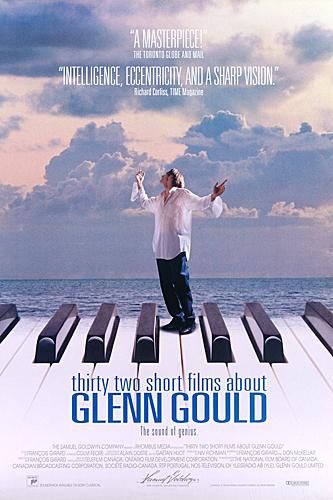

I also have a sentimental attachment to Glenn Gould. My second date with my husband was to go to see the film “32 Short Films about Glenn Gould”. I knew that any man who would take me to such a film was someone of great intelligence and passion. After 14 years I can say that is more true than I can express.


I still watch video of Gould and am intrigued. He is other worldly and I believe that is what he was created to be. He is one of those musicians given to us as a gift. Thankfully, we have the pleasure of having him captured on film for all time.


Read More

Saturday, July 25, 2009

The G.G. Möbius

A Möbius strip is a one-sided object. It is constructed by taking a strip of paper, giving it a half-twist and joining the ends together. In theory, however, a perfect Möbius strip is unbroken—i.e. it does not involve joining two ends together, but is seamless.

The Möbius strip is a kind of infinite loop. If you were to walk along its length you would cover both "sides" without crossing an edge, and end up back where you started. Modern artists have been fascinated by the Möbius strip as well the idea of recursive looping in general. Visual artists such as M.C. Escher and Oscar Reutersvard have used infinitely looping images in their work. Musician Steve Reich has famously created musical works that loop back on themselves a well as shift through various phase relationships.

In his video installation The G.G. Mobius, visual artist and musician Matt Evans presents an infinite, phasing loop that is both visual and musical.


Read More

Monday, July 20, 2009

Guest Blogger - Yuka Zuver

The Contrapuntal Blog Guest Blogger Series begins now. The purpose is to showcase some of the worlds most passionate and creative Gould fans' creations through photo, video and writing.

Yuka Zuver (@StudioDaCapo) is a Japanese-born self-taught pencil artist.
Over the past few years she has focused her drawing talent on portraits including Glenn Gould.
The late Canadian pianist has been the main inspirational subject since 2006 and continues to motivate in all elements of her artworks.

She lives in the United States, on Whidbey Island near Seattle with her husband, two daughters, and a dog.


Read More

Saturday, May 16, 2009

The Prospects of Cyberchondria.


Some time ago we considered the possibility that Glenn Gould would have benefited from today's technology to do stuff that he wanted to do but wasn't possible at the time. Imagine what GG could have done with today's information technologies. It may have produced some awesome results. Or maybe not. If you've ever found that the internet can be a more pernicious time-waster than TV ever was, then you know that technology can be a hindrance as much as a help. It's all up to you to determine which it will be.

For example, consider popular reference sites like
MayoClinic.com. If you're feeling sick you can use this site to gain useful information on your condition that will help you make a rational decision about what course of action to take, if any. Or, if you're so inclined, you can use the site to determine without exception that every little ache or pain you feel is a sure sign that you have six weeks left to live. If you fit the latter description you would be what is known as a cyberchondriac. Based on what we know of Glenn Gould's personality, do you think it's possible that if he were alive today that he would have been an obsessive cyberchondriac? Yes, that is a rhetorical question.

Gould took careful notes about every real or imagined symptom he ever felt. A typical list is reproduced in
Kevin Bazzana's biography of Gould. The single handwritten page lists: 1) escalating blood pressure; 1A) chills and shivering; 2) plugged nostrils and some difficulty breathing; 3) gastro-intestinal troubles that he associated with a hiatial hernia; and 4) several months in which he was sleeping only three to four hours at a time. Let's use the trusty MayoClinic.com Symptom Checker to find out what these symptoms mean!

Well, there isn't an entry for high blood pressure as a symptom, so we'll just assume that this means
hypertension.

As for "chills and shivering" this could be symptomatic of anything, including the common cold. But it couldn't possibly be that. In view of the co-incidental presentation of joint pain documented elsewhere in GG's notes, I'd say this is a clear indication of
Septic Arthritis.

"Plugged nostrils and some difficulty in breathing:" combined with other reports of mild body aches and "puffiness in eyes" obviously indicates
Acute Sinusitis.

"Gastro-intestinal troubles:" although Gould associated these with a possible hiatial hernia, with the help of modern information technology, he could have arrived at the much more alarming diagnosis of
Gastroesophageal Reflux Disease (GERD).

Finally, the report of "sleeping only three to four hours at a stretch." According to MayoClinic.com "Conditions linked with insomnia include arthritis, cancer, congestive heart failure, diabetes, lung disease, gastroesophageal reflux disease (GERD), overactive thyroid, stroke, Parkinson disease and Alzheimer's disease." So, if there was any doubt about the diagnosis of GERD, above, this pretty much nails it. And, just to be thorough, I would assume the presence of at least two of the other possible underlying causees for this symptom.

MayoClinic.com sure is a lot of fun! Go ahead and try it out. As for myself, I've already determined that I am practically a dead man.
Read More

Wednesday, February 11, 2009

One Cole

Glenn Gould called himself “the last Puritan”—a claim consistent with his seemingly Gnostic attitude toward the physical world. He took no pleasure in eating, could not tolerate alcohol, avoided physical contact with other people, had minimal regard for his personal appearance, lived in a Spartan apartment outfitted with dull, functional furniture, and had an almost allergic aversion to color. When Gould was a child, his mother took him to see Disney’s Fantasia. The film’s celebrated abundance of bright color made him feel ill, and he had to go home and lie down. In fact Gould’s favorite color was one that most of us consider depressing: battleship grey.

In Toronto the color grey is, shall we say . . . prevalent. Of course this is one of the many reasons that Gould liked Toronto. Personally, I enjoy grey as much as the next guy but, by the time it gets to be February, I’m starting to get just a little tired of it. And so I was surprised this afternoon to be impressed by a new building so perfectly grey that, right on the spot, I was moved to imagine an award for which it could be nominate
d: The Glenn Gould Memorial Award for Outstanding Civic Achievement in Greyness (GGMAFOCAG).

One Cole
, currently under construction, is the first building in Phase One of the renewal project for Regent Park, Toronto’s oldest social housing community. Back in the 1940’s civic planners thought that the best way to design social housing was to create a kind of isolated park in the midst of the city. Reality, however, did not play out according to their theories; while the “isolation” part of the concept came through pretty strongly, the “park” aspect did not. Better integration with the city was needed. Furthermore, the individual buildings of Regent Park had deteriorated to the point where replacing them was more practical than trying to renovate them.

And so Regent Park will soon have new buildings that will be much better designed, much better built and, if One Cole is a reliable leading indicator, much more grey.

Now, given the bad reputation that grey has acquired over time, I hasten to make it clear that I consider the greyness of One Cole to be a positive thing. The building’s worthiness of the GGMAFOCAG is not on account its exc
essive quantity of greyness, but rather on the outstanding quality of its greyness.

Many of Toronto’s buildings date from the 1970’s and are grey merely because the budget was tight, and pre-cast concrete is relatively inexpensive.


One Cole is not like that, however. Since it’s clad in brick it could be any color in which brick is available (which, admittedly is not the most exciting range of colors, but anyway.) The grey brick of One Cole was chosen specifically for its aesthetic properties and it shows. One Cole takes the idea of grey and runs with it. Feel the excitement.

I took the pictures here with my phone, so they’re not the best quality and they don’t really do justice to the building. But I hope you get the idea. This is just the first building of many in a large project. When the new Regent Park is finished, the whole area from Dundas to Gerrard and from Parliament to River will be covered in battleship-grey buildings like One Cole. If Glenn Gould were around today he might even be eager to move in.

Read More

Sunday, February 08, 2009

So You Want to Play Bach's Prelude No. 3

My latest trial by fumbling is Bach's Prelude No. 3. It is beautiful and tricky and this edition includes an awkward page turn after 12 bars. Like many adults attempting to master piano, I have a sense of how I wish to render the piece (though it often sounds like RENDING), if only the synapses would fire properly. I want the poco dims and the poco crescs to come out subtly, sensitively, exquisitely too, please.
And because Bach is nearly synonymous with Glenn Gould, I have been trying to decide whether I ought to listen to his recording of this Prelude. Though I have no doubt that my Prelude and his would hardly be recognizable as the same work, there is a strange sort of alliance going on. I would like to know what he has done with these clever unexpected accidentals, the balance of the left hand reaching for that low D, the resolve of the poco rit. What does one learn from another's interpretation of a piece? Why do some musicians avoid listening to someone else's version while others study it intently? What does Glenn, not even remotely in the same musical sphere as I, have to offer me? And will it be useful to me as my fingers are wont to play Broken Telephone with my head, producing what I did not have in mind at all?
Listening to Gould has its dangers. One begins to believe his is the definitive version. But does not everyone have his Idea of What It is Supposed to Be? When I consider the two versions of the Goldberg Variations recorded 26 years apart, I am reassured. Glenn believed in exploring. And changing his mind.
The possibilities are endless. Even my ham-fisted version.

Note-Maker
Read More

Monday, February 02, 2009

Man of the Future?

Throughout his professional life Glenn Gould was in touch with the latest developments in technology. It wasn't simply a matter of keeping "up to date" with it but more of being inspired by it. New innovations in recording and broadcast technologies stimulated Gould's creative mind to imagine new artistic possibilities in much the same way as they did for contemporary rock musicians such as The Beatles.

The hackneyed phrase "ahead of his time" never really makes any sense. But it could be said to apply to Gould at least insofar as he had certain ideas which became technically possible only decades after his death. For example, Gould was enthusiastic about the possibility of enabling listeners to become creative partners in the recorded music experience. He recognized the potential for this simply from the fact that listeners at the time could control some very basic sonic parameters, such as frequency equalization, on their stereo systems. But this amount of control is relatively trivial. Gould wanted to go further and he imagined giving listeners kits composed of the individual parts of a piece of music which they could then re-assemble to their preference. At that time it was practically unfeasible to do this. Today however, it's easy. Simply post individual audio tracks for download on the web and then let people reassemble them in GarageBand, ProTools, or the audio application of their choice. And in fact this is now common practice.

Consider the technology available to GG. Look, for example, at the chart at the top of this page. It's a score from Gould's radio documentary The Latecomers. It is drawn on a piece of paper. With a felt-tip marker. Forget ProTools. We're going to go cut up some tape now. Let's refer to the graph.

What's more interesting, however, is that Gould's idea was ahead of its time not just technically but also socially. Even if it were possible in the 1960s and 70s to distribute the kind of musical self-assembly kits Gould envisioned, it is hard to imagine that anyone would have wanted them. This too has something to do with technology. Not the technology of recording but rather that of social networking.

As Lawrence Lessig points out in this lecture, for most of the 20th century we lived in a "read-only" society. That is to say, a culture wherein a small group of people is professionaly responsible for producing cultural goods (i.e. they do the "writing"), which are then broadcast out to a wide audience of "consumers" (who do the "reading.") In such a culture, one's role as a producer or a consumer is clearly defined. This cultural condition was largely a result of the kind of mass media that—ironically—made Gould's carreer possible. Broadcast radio & television, mass-market publishing, and record manufacturing/distribution all have a "one-to-many" profile, like someone with a megaphone addressing a large crowd of people. Again, one person does the talking. Everyone else does the listening.

Sometime around the turn of the milennium, however, that paradigm collapsed as the internet allowed everyone to become a producer and consumer in equal measure—to the point where those terms may soon become culturally meaningless. The internet is the world's first "many-to-many" communication platform. In the space of only a few years our culture has transformed from a monologue into a conversation.

And this is just the social transformation that had to take place for Gould's idea to work. What Gould was really proposing way back in the 70's was open source music. I think Gould probably assumed that most people have a natural creative impulse strong enough to create a demand for open source products. The degree to which people now post, remix, and share their own creative work online suggests that this assumption was correct. But the prevailing 20th century "read-only" culture made this hard to see at the time. In fact, not only did few people have the imagination to conceive of such a culture in the 1970s but, even today, those who have a professional stake in traditional media are seemingly blind to its emergence, even as it springs up all around them.

Read More